The Zero-Friction AI Layer: A Practical Guide to Keyless Infrastructure for Web Developers
Explore the strategic frameworks, practical engineering workflows, and critical production trade-offs of using keyless, anonymous AI infrastructure in modern web applications.
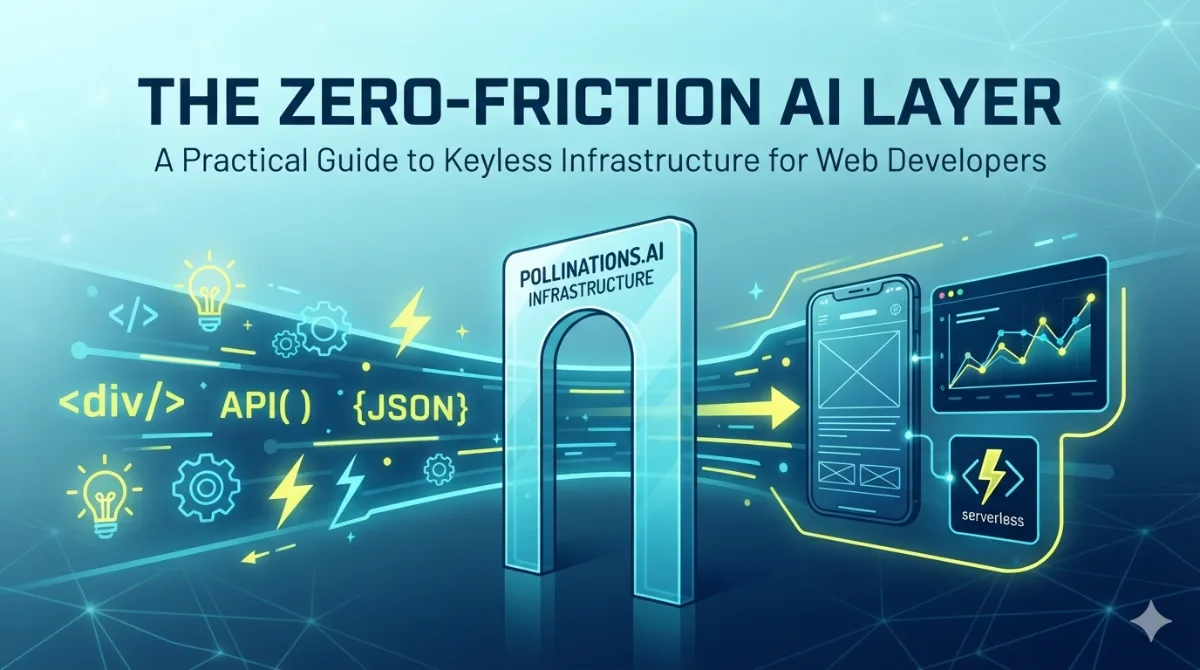
In the rapid evolution of modern web development, adding Artificial Intelligence to a project usually begins with a familiar chore checklist. Developers must sign up for a cloud console, verify a phone number, input a credit card for "free tier" monitoring, generate a cryptographic token, and inject it securely into environment variables.
Pollinations.ai breaks this convention entirely. It offers an open, community-powered AI endpoint infrastructure that requires no logins, no API keys, and no account generation.
While a keyless API might sound like a simple toy for hobbyists, it serves as a highly practical architectural asset when applied to the right technical workflows. This guide explores the strategic frameworks, real-world use cases, and technical trade-offs of using keyless AI infrastructure in modern web applications.
The Mechanics: How Does a Keyless AI API Function?
To evaluate the utility of an anonymous endpoint, it helps to understand the underlying infrastructure. Traditional developer platforms authenticate incoming requests by checking an API token string sent via an Authorization header. In contrast, an open AI engine relies on IP-based traffic monitoring and open-weight model routing.
When a payload hits the infrastructure, the server checks the origin IP address against its current global capacity limits. The request is then dynamically queued and processed by community-managed hardware nodes running open-weight models like Llama, Mistral, Qwen, or Flux.
For web developers, this means the API treats data fetching identically to grabbing an image from a standard public asset server or requesting data from a public JSON file. It completely removes the need for state authentication layers during the initial connection phase.
3 Broad Practical Scenarios in the Engineering Pipeline
1. Rapid Prototyping & Frictionless MVPs
In the initial stages of product scoping—such as client discovery phases, internal hackathons, or interactive wireframing—the primary goal is proving a concept before sinking capital or time into setup.
Setting up commercial cloud access credentials for temporary proof-of-concept (PoC) builds creates administrative bloat. By utilizing an open routing engine, development teams can skip token provisioning completely. If a prototype gets scrapped or heavily modified after a client presentation, zero time was lost setting up, budgeting, or cleaning up cloud accounts.
2. Context-Aware Dynamic Mock Data
Traditional UI/UX component testing typically relies on hardcoded placeholder values ("Lorem Ipsum") or fixed asset directories. This approach fails to accurately simulate how a layout handles unpredictable, live user inputs.
Engineering teams can use keyless endpoints as dynamic data generators during local development. For example, if a developer is testing an e-commerce dashboard template, the layout can fetch live, contextually matching descriptions and imagery based on whatever dummy product name is typed into the testing suite. This ensures edge cases in UI responsiveness—like variable text lengths and sudden image aspect ratios—are caught before committing code.
3. Decoupled Edge Routing and Micro-Services
When building applications deployed on modern serverless edge networks, managing cold starts, payload sizes, and environment variables across multiple staging environments introduces configuration overhead.
A keyless API acts as a completely stateless engine. Because there are no secrets or keys to inject into the runtime environment of an edge function or a serverless worker, the deployment configuration remains entirely decoupled. The code becomes highly portable; it can be cloned, shifted to an entirely different cloud host provider, or run locally on a developer’s machine instantly without modifying environment panels.
Strategic Trade-offs: The Production Boundary
Deploying an anonymous endpoint requires an objective understanding of its constraints. A keyless model shifts operational characteristics away from traditional enterprise guarantees, which introduces three specific engineering boundaries:
- Variable Latency vs. Dedicated Throughput: Paid, key-guaranteed clouds allocate dedicated hardware slices or strictly metered token-per-minute (TPM) limits to your specific account profile. Keyless public networks operate on a shared-pool basis. If a massive global event spikes traffic elsewhere on the public network, your project's performance will experience variable latency or temporary throttling.
- Breaking Structural Changes: Because there is no user database or profile registry, the maintaining community cannot send email alerts regarding upcoming API deprecations, path rewrites, or model retirements. The system expects the consumer's codebase to be resilient enough to gracefully handle dynamic model adjustments or fallbacks.
- Client Exposure Vulnerabilities: When integrating a keyless tool, developers must consciously decide where the fetching logic lives. Calling an unauthenticated URL directly from a client browser means a malicious user can easily view the network traffic, deduce the underlying system prompts, and mirror those exact requests to exhaust the host application's local IP address allowances. Conceptually, a backend proxy layer (like a server endpoint or serverless routine) should still be used to shield internal logic.
| Infrastructure Paradigm | Ideal Deployment Scenario | Primary Technical Strengths | Operational Boundaries |
|---|---|---|---|
| Keyless Public AI (e.g. Pollinations.ai) | Local testing, MVPs, UI mock validation, hackathons | Zero auth secrets, instant visual feedback, decoupled | Variable latency, shared community pool, no SLA |
| Token-Managed Cloud (e.g. Paid Endpoints) | High-scale commercial SaaS, production grids | Dedicated TPM/RPM quotas, SLA guarantees, audit trails | Billing overhead, token leak risks, staging config bloat |
Operational Summary: When to Route Traffic
Choosing the right tool depends entirely on where your project sits in the software development lifecycle:
- Keyless Public APIs (e.g., Pollinations.ai): Ideal for local feature testing, UI layout validation, hackathons, client demos, and early PoCs. The primary benefits are zero configuration setup, immediate visual feedback, and no account overhead.
- Managed Account APIs (Paid/Token-Based): Ideal for high-scale production grids and commercial SaaS platforms. The primary benefits are dedicated throughput SLAs, detailed account logging, and guaranteed uptime.
The Final Architectural Takeaway
Public, keyless AI infrastructure represents a functional tool in a modern developer's utility belt. It is not designed to replace high-availability corporate cloud instances for customer-facing production grids. Instead, it serves as a hyper-efficient catalyst for the building phase—removing administrative friction and letting engineers focus strictly on validating features, optimizing layouts, and refining user workflows.
Key Architectural Takeaway: Public, keyless AI infrastructure serves as an agile catalyst during early product discovery—eliminating administrative credentials and allowing engineers to validate features, mock dynamic states, and test responsive UI boundaries with zero friction.
On This Page

Subscribe to One2Tech Insights
Stay updated with our latest development and tech guides.
More from UI/UX
View allThe Modern Engine of Enterprise: Why Java Rules the Tech World (and Generates Billions) in 2026
When we talk about the latest trends in software, terms like artificial intelligence, cloud-native microservices, and rapid web frameworks take center stage.
Supabase October 2026 Update: New Developer Tools, Turso Acquisition, AI Integrations, and More
Supabase's October 2026 update highlights new developer tools, the acquisition of Turso, AI integrations, and more, showcasing the evolving developer ecosystem.