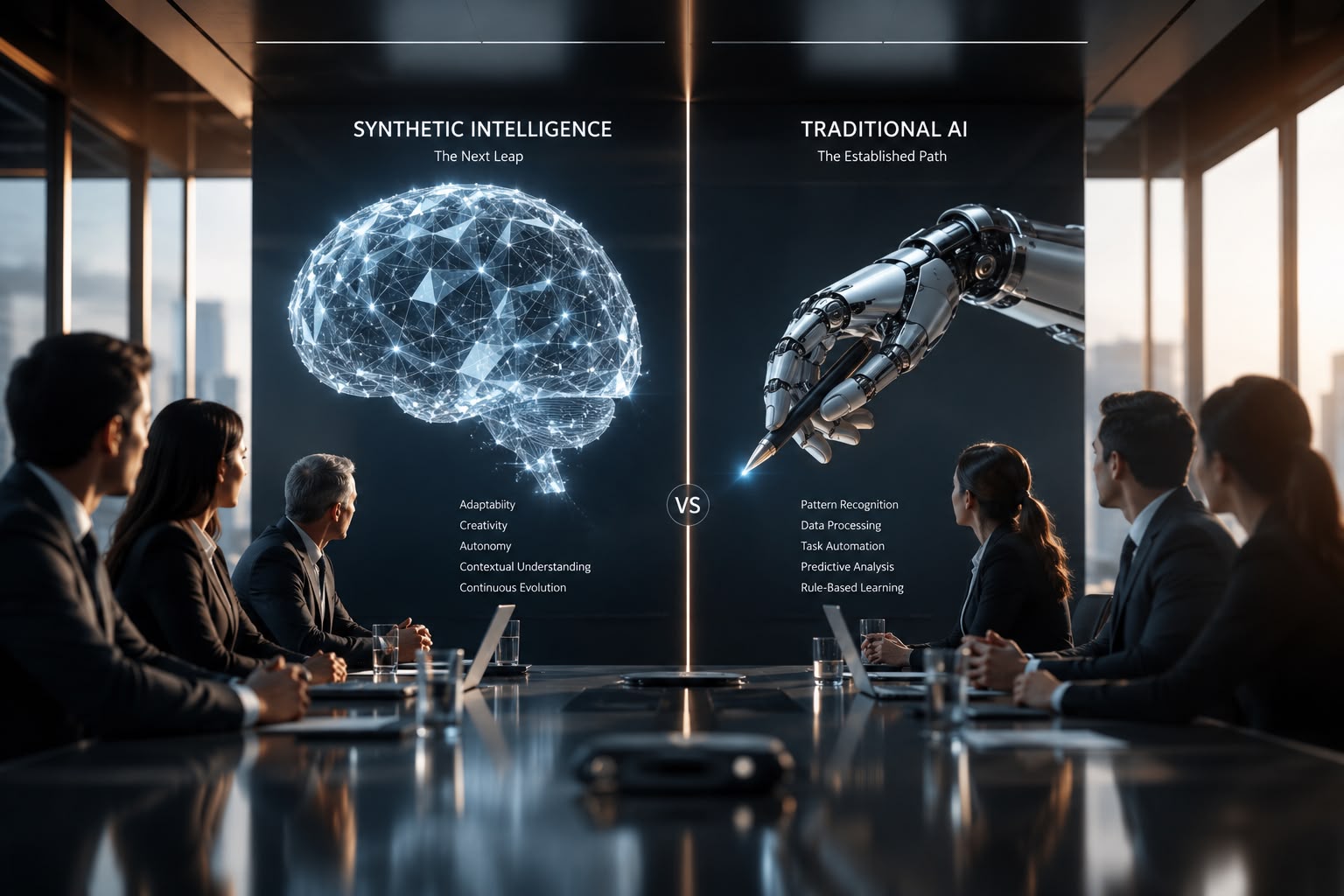
Synthetic Intelligence Could Be the Next Big Shift After AI
The world of technology never stands still.
Just when businesses are beginning to fully embrace Artificial Intelligence, another concept is starting to gain attention—Synthetic Intelligence (SI).
While AI has already transformed productivity, automation, and software development, many experts believe the next phase of intelligent systems won't simply be "better AI."
Instead, it may involve systems capable of learning continuously, making independent decisions, adapting over time, and operating with far greater autonomy.
If that vision becomes reality, Synthetic Intelligence could reshape not only technology—but also business strategy, governance, and competitive advantage.
AI vs. Synthetic Intelligence: What's the Difference?
One of the easiest ways to understand the difference is through a diamond analogy.
💎 Artificial Intelligence: The Skilled Imitator
Think of traditional AI like Cubic Zirconia.
It looks impressive.
It performs many useful tasks.
But fundamentally, it's designed to imitate human intelligence.
Most AI systems today:
- Respond to prompts.
- Perform specific tasks.
- Generate outputs.
- Lose much of their working context between sessions.
- Depend heavily on human direction.
In other words, AI is an intelligent tool that becomes active when someone asks it to perform a task.
💠 Synthetic Intelligence: Intelligence That Evolves
Now imagine a lab-grown diamond.
It isn't simply an imitation.
It's engineered to possess the essential characteristics of a real diamond.
Synthetic Intelligence follows a similar philosophy.
Rather than only responding to instructions, SI aims to develop increasingly sophisticated decision-making capabilities by continuously learning from experience.
Instead of simply executing commands, future synthetic systems may be able to:
- Analyze changing situations.
- Make decisions independently.
- Learn from previous outcomes.
- Improve their own performance over time.
That's why many researchers describe SI not simply as software—but as an autonomous digital actor.
Five Signs a System Is Moving Toward Synthetic Intelligence
Not every AI system qualifies as Synthetic Intelligence.
However, several emerging characteristics distinguish these next-generation systems.
1. Sustained Autonomy
Traditional AI usually waits for human input.
Synthetic systems are designed to continue operating for extended periods without constant human intervention.
Rather than completing a single task and stopping, they may continuously monitor, analyze, and execute long-running objectives.
2. Persistent Identity
Most AI assistants start almost every conversation from scratch.
Synthetic Intelligence takes a different approach.
It maintains long-term memory, retains previous experiences, and continuously builds context over time.
Instead of repeatedly "meeting you for the first time," it gradually develops a richer understanding of users, projects, and organizational knowledge.
3. Real-World Agency
Conventional AI often provides recommendations.
Synthetic systems aim to go a step further.
They can potentially interact with real-world digital infrastructure by:
- Working with APIs
- Executing code
- Managing cloud resources
- Handling credentials
- Operating business workflows
- Completing digital transactions
The difference is significant.
Instead of merely suggesting actions, these systems may actually perform them.
4. Self-Improvement
One of the defining characteristics of Synthetic Intelligence is continuous adaptation.
Rather than relying solely on developers to improve the system, future SI platforms may refine their own workflows, optimize strategies, and improve decision-making based on accumulated experience.
The system itself becomes part of the learning loop.
5. Generative Independence
Perhaps the most advanced capability is the ability to create new solutions independently.
If a task requires capabilities the system doesn't currently possess, future synthetic systems may:
- Create new sub-goals.
- Develop supporting tools.
- Coordinate with specialized AI agents.
- Delegate work across multiple systems.
Instead of following a fixed sequence of instructions, they become capable of dynamically expanding their own problem-solving approach.
How Synthetic Intelligence Could Change Business Strategy
The biggest impact of Synthetic Intelligence may not be technical.
It may be organizational.
Governance Will Need to Change
Most AI governance today focuses on reviewing outputs.
But when intelligent systems begin making independent decisions, monitoring outputs alone won't be enough.
Organizations will also need to evaluate:
- Decision quality
- Behavioral consistency
- Risk management
- Operational boundaries
- Accountability
Governance itself will have to evolve alongside the technology.
Intelligence May Become a Compounding Asset
Today, software is often evaluated based on features, pricing, and performance.
Synthetic Intelligence introduces another dimension.
Because these systems continuously learn from organizational experience, their value may increase over time.
The longer they work within a company, the more context they accumulate—and the more useful they potentially become.
In that sense, intelligence itself could become a long-term business asset.
Competition Could Become 24/7
Human teams eventually stop working.
Synthetic systems don't necessarily have to.
Future AI systems may continue operating around the clock by:
- Running experiments
- Improving software
- Optimizing workflows
- Testing business strategies
- Monitoring performance
This could fundamentally change how organizations think about productivity and competitive advantage.
What Should Business Leaders Do Today?
Even if Synthetic Intelligence is still evolving, organizations can begin preparing now.
✅ Audit Your Current AI Capabilities
Understand where your existing systems already support:
- Long-term memory
- Autonomous workflows
- Multi-agent collaboration
- Independent decision-making
Knowing your current maturity level helps identify future opportunities.
✅ Define Clear Decision Boundaries
Before giving AI greater autonomy, establish clear rules for:
- Which decisions AI can make independently.
- Which actions require human approval.
- Who remains accountable for outcomes.
Strong governance becomes increasingly important as AI gains more operational responsibility.
✅ Control Your Context Layer
Organizational memory matters.
Logs, interaction history, workflows, orchestration systems, and internal knowledge increasingly become strategic assets.
Businesses should understand where that context is stored and who ultimately controls it.
✅ Increase the Speed of Governance
AI systems evolve rapidly.
Governance should evolve at a similar pace.
Quarterly reviews may no longer be sufficient if AI behavior changes continuously.
Organizations should adopt ongoing monitoring that can identify unexpected behavior before it becomes a larger operational risk.
Final Thoughts
Artificial Intelligence taught machines how to respond intelligently.
Synthetic Intelligence represents a broader vision—one where intelligent systems can continuously learn, adapt, make decisions, and operate with greater independence.
Whether SI ultimately becomes the industry's next major milestone or evolves alongside today's AI, one thing is becoming increasingly clear:
The conversation is shifting from "How intelligent is the model?"
to
"How independently can the system operate?"
For business leaders, that shift may prove to be just as important as the AI revolution itself.
