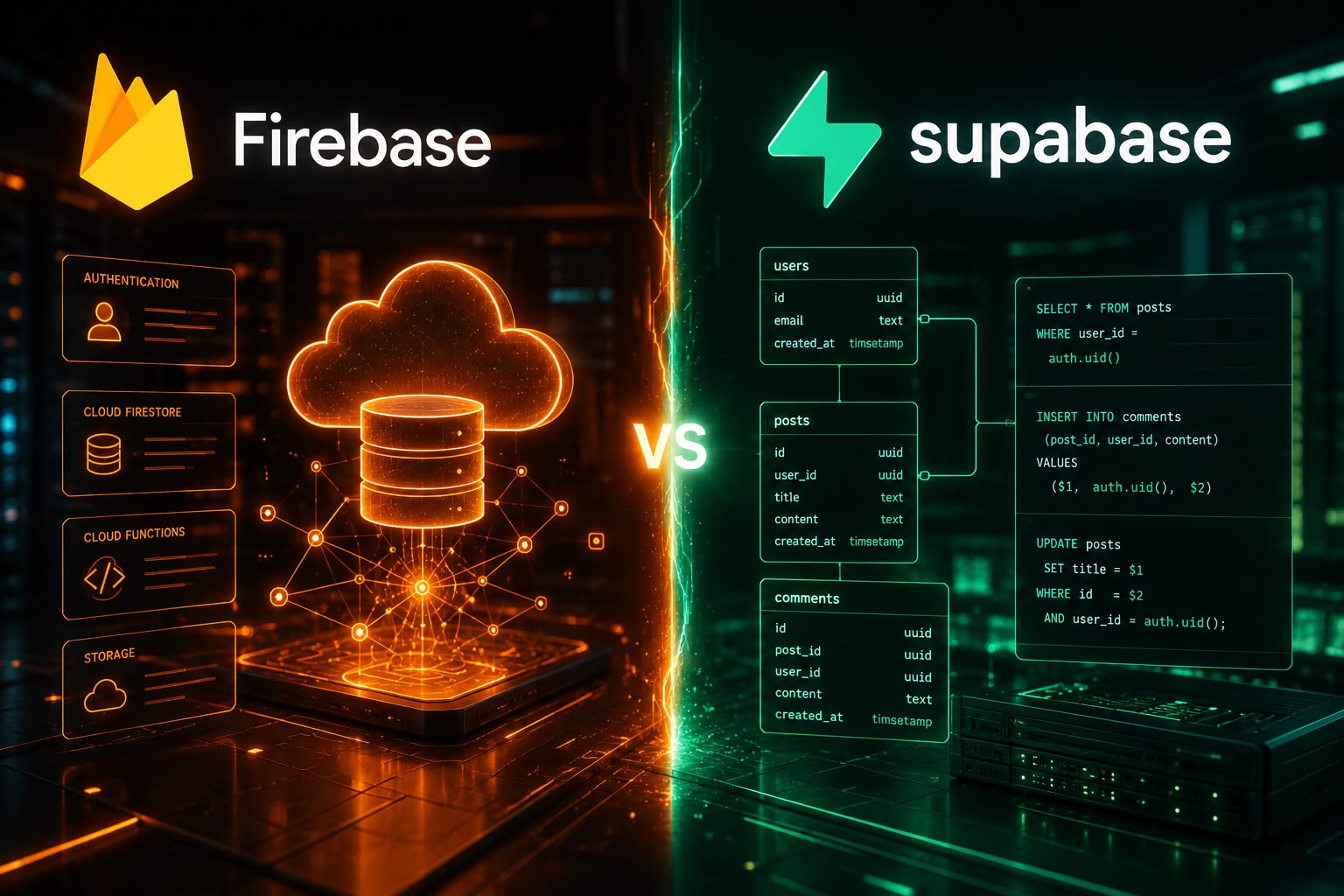
Firebase vs Supabase: Why This Debate Matters More Than Ever
Building a modern app isn't just about creating a beautiful frontend.
Behind every mobile app, SaaS platform, eCommerce website, or AI product is a backend that manages users, databases, authentication, file storage, and business logic.
Building all of that from scratch takes time, infrastructure, and ongoing maintenance.
That's exactly why Backend-as-a-Service (BaaS) platforms have become so popular.
For years, Google Firebase was the default choice for developers. But over the last few years, Supabase has gained massive popularity by offering an open-source alternative built on PostgreSQL.
Today, one question keeps coming up in developer communities:
Should you choose Firebase or Supabase for your next project?
The answer depends entirely on your project's requirements, future scalability, and how much control you want over your backend.
What Is a Backend-as-a-Service (BaaS)?
Think of a BaaS platform as a ready-made backend.
Instead of building authentication systems, databases, APIs, storage services, and real-time infrastructure yourself, a BaaS provider gives you these building blocks out of the box.
This allows developers to spend more time building products instead of managing servers.
Whether you're creating a chat application, CRM, SaaS platform, portfolio website, or AI-powered application, a BaaS platform can dramatically reduce development time.
What Do Firebase and Supabase Actually Provide?
Although their architectures are different, both platforms solve many of the same backend problems.
📦 Database Management
Both platforms let you securely store application data without managing your own database servers.
Typical use cases include:
- User profiles
- Products
- Orders
- Messages
- Blog posts
- Application settings
The difference lies in how that data is stored, which we'll explore shortly.
🔑 User Authentication
Authentication is built into both platforms.
Developers can quickly add:
- Email login
- Password authentication
- Google Sign-In
- Apple Sign-In
- Magic Links
- Password reset
without building a complete authentication system from scratch.
☁️ File Storage
Need users to upload profile photos, PDFs, videos, or documents?
Both Firebase and Supabase provide cloud storage that integrates directly with your application.
⚡ Real-Time Features & Serverless Functions
Modern applications increasingly rely on real-time experiences.
Both platforms support features like:
- Live chat
- Notifications
- Collaborative editing
- Event-driven backend logic
without requiring developers to manage traditional servers.
A Brief History of BaaS Platforms
The evolution of Backend-as-a-Service can be divided into three major phases.
📱 Phase 1: Parse Popularized Mobile Backends (2011–2014)
As smartphones exploded in popularity, developers needed faster ways to build backend infrastructure.
Parse became one of the first major BaaS platforms and was later acquired by Facebook (now Meta), helping popularize the entire category.
🔥 Phase 2: Firebase Became the Industry Standard (2014–2020)
Google acquired Firebase and rapidly expanded it into one of the world's most comprehensive backend platforms.
Its integration with Google's ecosystem made it the default choice for millions of developers.
🚀 Phase 3: Supabase & the Open-Source Movement (2020–Present)
Supabase entered the market with a simple but compelling vision:
Offer Firebase-like simplicity while giving developers the power of PostgreSQL and open-source technology.
That combination quickly attracted startups, SaaS founders, and developers looking for greater flexibility.
The Biggest Technical Difference
Although Firebase and Supabase solve similar problems, they are built on completely different foundations.
| Feature | Firebase | Supabase |
|---|---|---|
| Database | Firestore (NoSQL) | PostgreSQL (Relational SQL) |
| Source Model | Closed Source | Open Source |
| Data Structure | Collections & Documents | Tables & Relationships |
| Self Hosting | No | Yes |
| SQL Support | No | Full PostgreSQL SQL |
This architectural difference influences almost every other decision you'll make.
NoSQL vs PostgreSQL: Which Database Fits Your Project?
This is arguably the most important comparison.
🔥 Firebase (Firestore)
Firestore is a NoSQL document database.
Instead of tables, it stores information in collections and documents.
It's particularly well suited for applications where data changes frequently and doesn't follow a rigid structure.
Examples include:
- Live chat
- Social media feeds
- Real-time messaging
- Activity streams
However, as relationships between data become more complex, queries can become increasingly difficult to manage.
Imagine an eCommerce application where:
User → Orders → Products → Payments
Managing these relationships in NoSQL often requires additional planning and duplicated data.
💎 Supabase (PostgreSQL)
Supabase is powered by PostgreSQL—one of the world's most trusted relational databases.
This makes it particularly strong for applications with structured relationships.
Examples include:
- SaaS platforms
- CRM software
- ERP systems
- FinTech applications
- eCommerce platforms
- Inventory management systems
PostgreSQL also supports advanced SQL queries, joins, constraints, views, stored procedures, and many enterprise-grade features developers have relied on for decades.
Why AI Developers Are Looking at Supabase
One of Supabase's biggest modern advantages is its growing AI ecosystem.
It supports pgvector, an extension that allows PostgreSQL to store and search vector embeddings.
This makes Supabase particularly attractive for projects involving:
- AI chatbots
- Retrieval-Augmented Generation (RAG)
- Semantic Search
- Recommendation Engines
- LLM Applications
- AI Knowledge Bases
If your roadmap includes AI features, this capability can become a major advantage.
The Vendor Lock-in Debate
Perhaps the biggest reason developers compare these platforms isn't performance—
It's flexibility.
⚠️ Firebase
Firebase is deeply integrated into Google's ecosystem.
That integration is convenient, but it also means your backend architecture becomes closely tied to Firebase's services.
If you eventually decide to migrate elsewhere, the process can require significant redevelopment depending on how extensively Firebase-specific features have been adopted.
This is commonly referred to as vendor lock-in.
✅ Supabase
Supabase follows a very different philosophy.
Because it's open source, developers have multiple deployment options.
You can:
- Use Supabase Cloud.
- Self-host using Docker.
- Deploy on AWS, DigitalOcean, Azure, or your own servers.
That flexibility gives organizations more control over infrastructure and future migration options.
Pricing: Predictability Matters
Pricing is another area where these platforms differ.
💰 Firebase
Firebase offers a generous free tier.
After that, pricing is largely based on usage, including operations such as reads, writes, and deletes, along with other service-specific metrics.
This works well for many applications, but costs can become difficult to predict as traffic grows or application usage patterns change.
💵 Supabase
Supabase also offers a generous free plan, followed by paid tiers with clearer resource allocations.
Pricing generally focuses on factors such as:
- Database size
- Storage
- Bandwidth
- Compute resources
For many teams, this makes long-term budgeting easier to estimate.
When Should You Choose Firebase?
Firebase is a strong choice if you need:
- ✅ Rapid MVP development
- ✅ Real-time mobile applications
- ✅ Deep integration with Google services
- ✅ Crashlytics
- ✅ Analytics
- ✅ AdMob
- ✅ Push Notifications
- ✅ A fully managed Google ecosystem
It's particularly attractive for startups that want to launch quickly without managing infrastructure.
When Should You Choose Supabase?
Supabase becomes increasingly attractive when your project needs:
- ✅ PostgreSQL
- ✅ SQL Queries
- ✅ Complex relationships
- ✅ SaaS architecture
- ✅ AI & Vector Search
- ✅ Self-hosting options
- ✅ Greater infrastructure control
- ✅ Reduced vendor lock-in concerns
It's especially popular among startups building long-term products that may need greater flexibility as they scale.
Final Verdict
Neither Firebase nor Supabase is universally "better."
They simply solve different problems.
Choose Firebase if your priority is rapid development inside Google's ecosystem, especially for mobile apps and projects that benefit from Google's integrated services.
Choose Supabase if you want the power of PostgreSQL, open-source flexibility, predictable scaling, stronger support for relational data, and a backend that's well positioned for modern AI applications.
The most important decision isn't choosing the platform with the longest feature list—it's choosing the one that best matches your product's architecture, growth plans, and long-term business goals.
Official Resources
- Firebase: https://firebase.google.com
- Supabase: https://supabase.com
