The AI Triopoly: Unpacking the Dominance of Google, OpenAI, and Anthropic
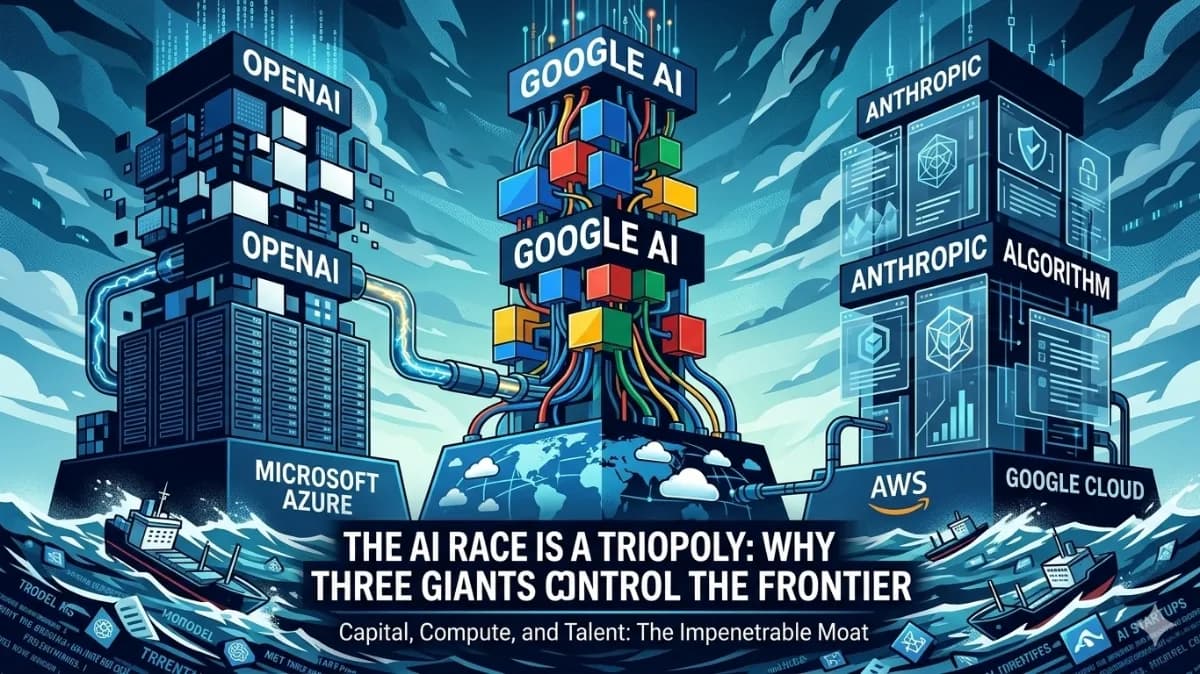
The global AI landscape appears vast, but beneath the surface, a triopoly of Google, OpenAI, and Anthropic controls nearly 90% of frontier AI capabilities. This trio has built an impenetrable moat around the future of technology, making it mathematically improbable for new entrants to break in. In this article, we'll delve into the data-driven breakdown of how these three players established their structural monopoly and why it's so difficult to disrupt.
The global artificial intelligence landscape feels infinitely vast. Every week, a new startup claims to have built the next "ChatGPT killer," and social media feeds are flooded with thousands of specialized AI tools.
Yet, if you peel back the marketing wrappers, you find an unmistakable truth: the entire foundational AI industry is a triopoly.
Imagine a market where nearly 90% of frontier AI capabilities are controlled by just three entities: Google, OpenAI, and Anthropic.
As thousands of smaller tech companies struggle to stay relevant, these three giants have built an impenetrable moat around the future of technology. From an editorial and architectural standpoint, here is the data-driven breakdown of how these three players established a structural monopoly on artificial intelligence—and why breaking it is mathematically improbable.
1. The Astronomical Capital Bottleneck
Building a frontier Large Language Model (LLM) is arguably the most expensive engineering feat in human history. To train a model capable of logic, coding, and real-time reasoning, a company needs access to tens of thousands of highly specialized AI chips.
- The Hardware Tax: A single advanced Nvidia AI graphics processing unit (GPU) costs tens of thousands of dollars. Frontier data centers require clusters of over 100,000 of these interconnected processors to train a single foundational model.
- The Energy and Server Bill: Training a next-generation model costs billions of dollars in raw electricity, infrastructure, and server maintenance alone.
- The Scale Frontier: Collective corporate spending on AI physical infrastructure is scaling past $3.5 trillion globally. This reality eliminates 99% of tech startups before they can even write a single line of training code.
2. The Cloud Hyper-Scaler Pipeline
Because the computational tax is so high, an AI company cannot survive as a standalone software business. They require direct, physical access to the world's largest server farms. The "Big Three" are the only entities directly anchored to massive cloud hyper-scalers:
- Google: The ultimate vertically integrated giant. Google owns its hyper-scale data centers, its proprietary hardware custom chips (Tensor Processing Units, or TPUs), and the global fiber-optic networks required to move massive training datasets seamlessly.
- OpenAI: Operates with immense computational backing via a deep, structural partnership with Microsoft. OpenAI runs its most advanced workflows on dedicated, highly customized sub-sections of Microsoft’s Azure cloud infrastructure.
- Anthropic: Positioned itself at the center of a massive cloud bidding war. The company secured a monumental $200 billion cloud agreement spread across five years with Google, while simultaneously leveraging multi-billion dollar capital and computing infrastructure investments from Amazon Web Services (AWS).
If a new, independent startup wants to build a competing model, they have to pay retail prices to rent servers from Amazon, Microsoft, or Google. In essence, they have to fund the very tech giants they are trying to disrupt.
3. Shared Scientific DNA and the Talent Oligopoly
The human brainpower required to engineer foundational AI models is exceptionally scarce. Globally, the pool of researchers capable of structuring, scaling, and aligning frontier models is estimated to be just a few hundred individuals.
Furthermore, the entire industry shares the exact same scientific lineage:
- The Invention: In 2017, a team of Google researchers published a groundbreaking paper titled "Attention Is All You Need." This paper introduced the Transformer architecture—the mathematical foundation behind every modern LLM, including ChatGPT, Claude, and Gemini.
- The Migration: Top talent left Google to apply these transformer mechanics at a young research lab called OpenAI, eventually scaling the architecture to create the GPT series.
- The Schism: In 2021, a group of core OpenAI safety researchers and executives walked out over disagreements regarding commercialization speed and corporate structure. They broke away to found Anthropic, establishing the Claude model lineup.
Virtually every major algorithmic breakthrough in generative AI over the last decade has bounced around inside this single, tight-knit network of engineers.
4. The Data Feedback Loop and Mass Distribution
An AI model is only as powerful as the information it digests and the user feedback it receives. The leading platforms have built an impenetrable moat because they already capture the vast majority of global data traffic:
- Google feeds its models through its dominant global web search traffic, billions of hours of YouTube video data, and the massive professional document pipelines flowing through Google Workspace.
- OpenAI leverages the largest consumer chat footprint on Earth, using hundreds of millions of active daily conversations to constantly refine model behavior and alignment.
- Anthropic commands a dominant share of enterprise-level software spending, allowing its systems to learn directly from high-value, structured corporate and legal data workflows.
This creates a compounding flywheel effect: more users generate more data, which creates better models, which attracts even more users. Independent startups are left scraping secondary data markets, making it mathematically difficult to catch up.
Editorial Verdict: Can Anyone Break the Triopoly?
From an industry-wide perspective, only two external entities possess the capital and scale to disrupt this structural chokehold:
- Meta (Llama): Mark Zuckerberg is deploying tens of billions of dollars to build frontier-class models and release them entirely open-source. While Meta does not sell a consumer subscription, their free code allows independent developers to build advanced software without paying a licensing tax to OpenAI or Google.
- xAI (Grok): Backed by Elon Musk, xAI has rapidly constructed massive computing clusters to directly challenge frontier logic models, utilizing real-time data integration from platform X to bypass traditional web scraping limits.
Beyond these hyper-capitalized outliers, the rule of the AI market remains absolute. For the foreseeable future, if you are interacting with advanced AI, you are operating within an ecosystem built, hosted, and controlled by Google, OpenAI, or Anthropic.
Key Architectural Takeaway: Public, keyless AI infrastructure serves as an agile catalyst during early product discovery—eliminating administrative credentials and allowing engineers to validate features, mock dynamic states, and test responsive UI boundaries with zero friction.

Subscribe to One2Tech Insights
Stay updated with our latest development and tech guides.
More from AI Careers
View all
How to Turn Your Android Phone into a Local Shared Drive Using Wi-Fi Hotspot
You can turn your Android phone into a local file-sharing server and access a specific folder from Windows, Mac, or other phones connected to its Wi-Fi hotspot.
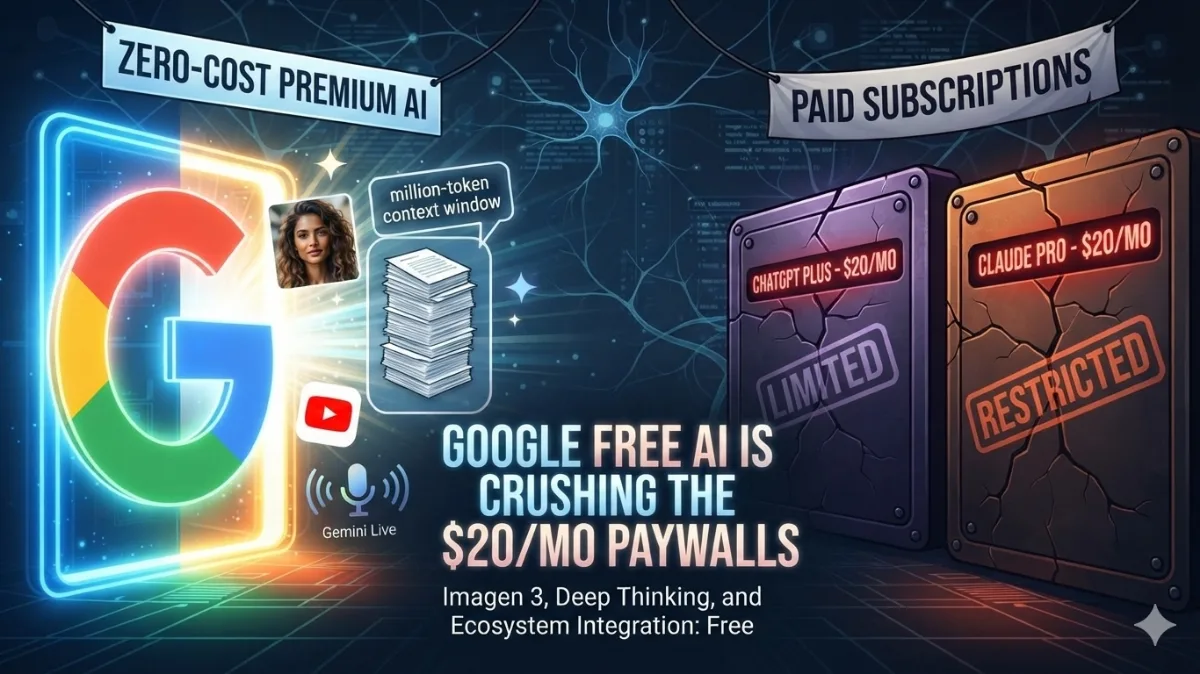
Google’s Free AI Trap: Why OpenAI and Anthropic Are Scrambling to Justify Their $20 Paywalls
If you are still paying $20 a month for ChatGPT Plus or Claude Pro, it might be time to check your bank statements.